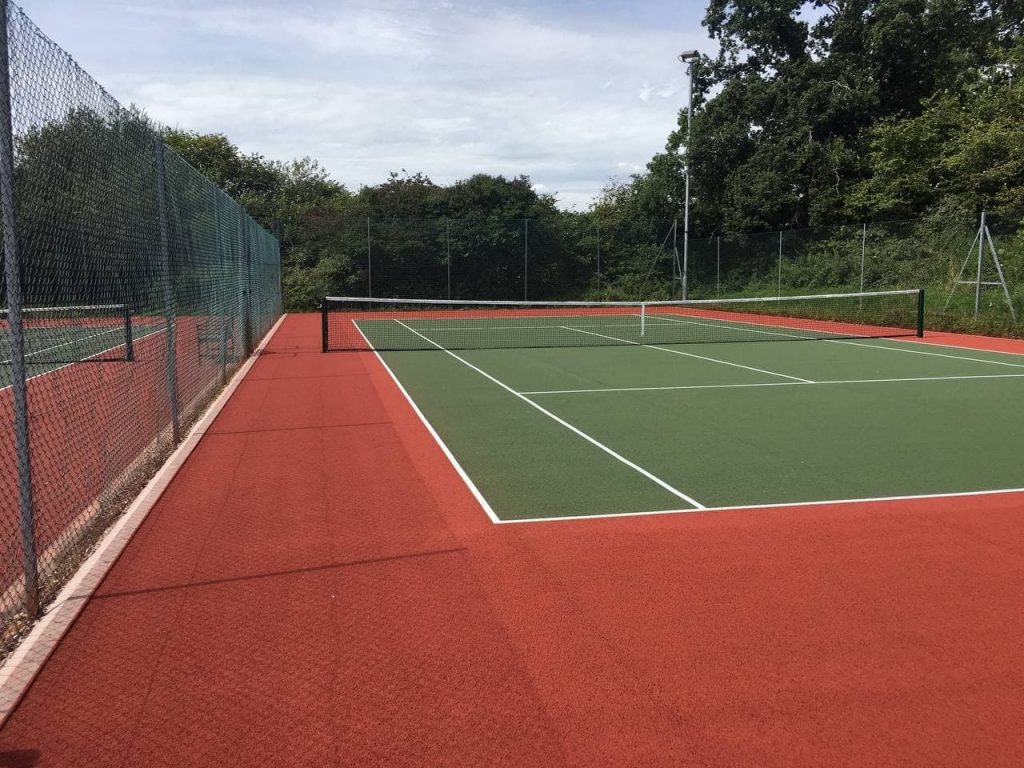
A heavily worn tennis court does not automatically require complete reconstruction. Surface fading, worn line markings, minor cracking and limited moss growth can often be addressed through professional refurbishment. However, resurfacing alone will not provide a lasting solution when deterioration originates within the base, drainage system or supporting ground.
The correct approach depends on why the court has deteriorated and whether its underlying construction remains stable. For court owners in Sussex, UK, a detailed condition assessment can establish whether refurbishment will restore dependable performance or whether reconstruction is the more appropriate option.
How to Decide Between Tennis Court Refurbishment and Reconstruction
The visible playing surface is only one part of a tennis court. Its performance also depends on the sub-base, drainage, surrounding ground, gradients and edge restraints. These elements should be considered together before work begins.
What Does Tennis Court Refurbishment Involve?
Refurbishment retains most of the existing court construction while improving its surface, drainage details or associated features. The precise work depends on the court’s condition and surface type.
A refurbishment programme may include:
- Thorough surface cleaning
- Treatment of moss and organic growth
- Repairing suitable cracks
- Correcting minor surface imperfections
- Improving localised drainage points
- Applying a new playing surface or coating
- Repainting court markings
- Repairing fencing and net equipment
Refurbishment is most effective when the existing base remains sound and the defects are largely confined to the upper surface.
What Does Reconstruction Involve?
Reconstruction addresses deterioration affecting the deeper layers of the court. It may involve removing the existing surface, excavating unsuitable materials and rebuilding the court from a properly prepared formation.
This approach provides an opportunity to correct:
- An unstable or contaminated sub-base
- Extensive settlement and movement
- Widespread structural cracking
- Incorrect levels or gradients
- Persistent drainage problems
- Damaged edge restraints
- A surface that can no longer support refurbishment
The aim is to resolve the causes of deterioration rather than place a new finish over an unreliable foundation.
Assess the Pattern of Cracking
The type and distribution of cracks can reveal much about the court’s condition. A small number of stable surface cracks may be repairable during refurbishment.
Concern increases when cracks are:
- Wide or continuing to open
- Reappearing after earlier repairs
- Spread across large areas
- Forming interconnected patterns
- Accompanied by sinking or raised sections
- Allowing vegetation to grow through the surface
These signs can indicate movement beneath the playing layer. Resurfacing without stabilising the underlying construction may allow the cracks to return.
Check for Unevenness and Settlement
A tennis court needs consistent levels to provide predictable ball response and safe movement. Depressions, ridges and sunken sections can interfere with play and cause water to collect.
Small localised imperfections may be corrected during refurbishment if the surrounding base is stable. Widespread undulation or continued settlement suggests that deeper reconstruction may be required.
Consider How Well the Court Drains
Standing water is an important warning sign. It may result from blocked outlets or limited surface defects, but it can also indicate incorrect falls, base settlement or a drainage system that no longer performs effectively.
Refurbishment may be suitable where drainage problems are confined to a clearly identifiable area. Persistent water across several sections requires a broader investigation before a new surface is installed.
Examine the Existing Surface Condition
A faded or worn court can still have a sound foundation. Loss of texture, worn markings and superficial surface deterioration may be addressed through cleaning, repairs and resurfacing.
Reconstruction deserves consideration when the surface is breaking apart, separating from the layers below or deteriorating across most of the court. The contractor should determine whether the existing material can provide a stable base for further treatment.
Look at Previous Repair Performance
Earlier repairs provide useful evidence about the condition of the court. A repaired crack that has remained stable may not be a cause for wider concern.
If patches repeatedly fail or cracks return through the same areas, the visible damage is probably being driven by movement beneath the surface. Repeating the same repair without addressing that movement is unlikely to produce a reliable result.
Check the Court Edges and Surrounding Ground
The perimeter helps support the court surface. Damaged edging, soil movement and poorly controlled vegetation can allow the outer sections to weaken or spread.
Tree roots and surrounding ground conditions may also contribute to displacement. These factors should be investigated before deciding whether the edge can be repaired locally or needs to be rebuilt as part of a wider project.
Consider the Desired Playing Performance
The appropriate solution should reflect how the court will be used. A residential court, club facility or frequently used shared court may have different performance requirements, but each needs a consistent surface with suitable grip, drainage and ball response.
Refurbishment can restore these characteristics when the structure remains stable. Reconstruction provides greater scope to correct fundamental levels, drainage and base conditions where the existing court cannot support reliable play.
When Refurbishment Is Usually Suitable
Refurbishment may be appropriate when:
- The base remains stable
- Cracking is minor and localised
- Surface levels are generally consistent
- Drainage performs adequately
- Wear is concentrated in the playing surface
- Previous repairs have remained intact
- The existing court provides a sound foundation
The work should still address the cause of each defect before a new finish is applied.
When Reconstruction Should Be Considered
Reconstruction may offer a more dependable outcome when:
- Structural cracking is widespread
- Large areas have sunk or moved
- Water remains on the court after rainfall
- The base has weakened or become unstable
- Previous repairs repeatedly fail
- Surface deterioration extends through several layers
- Court levels and gradients require substantial correction
Not every defective court needs to be rebuilt entirely. In some cases, only particular sections require deeper reconstruction while serviceable areas can be retained.
Why a Professional Court Assessment Matters
Surface appearance alone cannot determine the correct treatment. A professional contractor should inspect cracking, levels, drainage, edge support and the condition of the existing construction.
The assessment should distinguish cosmetic wear from structural failure. This avoids unnecessary reconstruction while preventing a new surface from being installed over defects that will quickly reappear.
Conclusion
Refurbishment is often suitable when a tennis court has a stable base but shows surface wear, faded markings or limited cracking. Reconstruction becomes more appropriate when movement, drainage failure or widespread deterioration affects the supporting layers.
If your tennis court in Sussex, UK, has become heavily worn, Tennis Court Construction Sussex can assess its complete condition and recommend an appropriate course of work. A careful inspection will establish whether targeted refurbishment or more extensive reconstruction is needed to restore dependable playing performance.
Call us on: 01892 351125
Click here to find out more about Tennis Court Construction Sussex
Click here to complete our contact form and see how we can help with your courts needs.