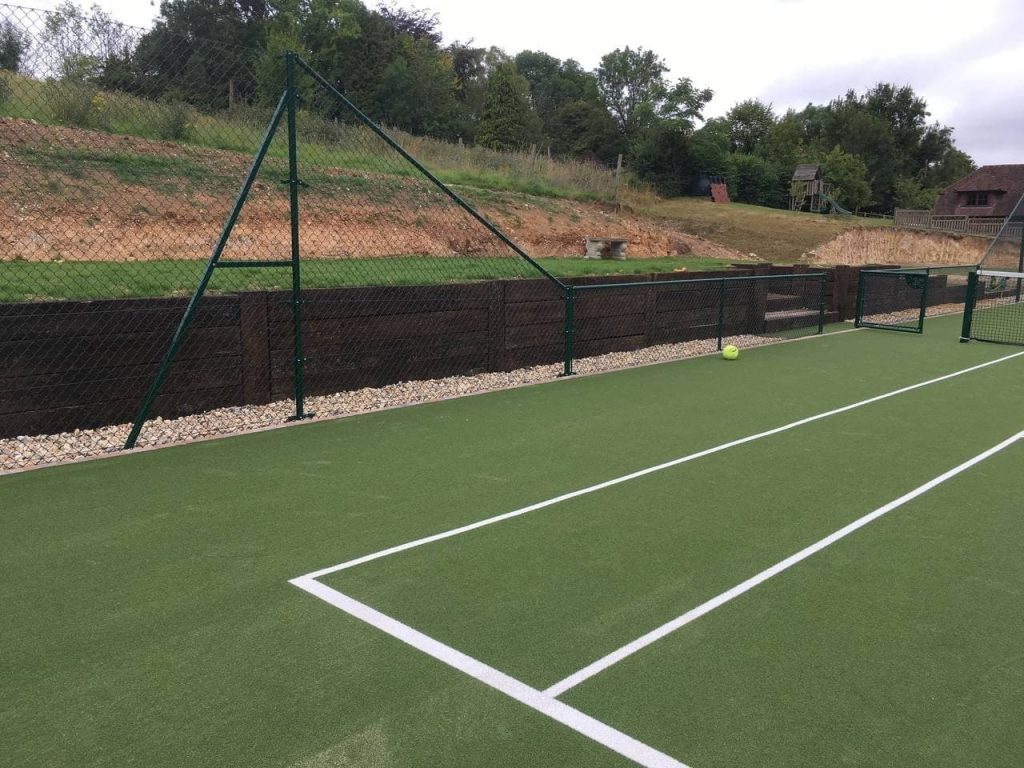
An underused section of land can often be transformed into a private tennis court, provided that the site has sufficient space and suitable ground conditions. What may currently be an uneven lawn, neglected paddock or rarely used part of a large garden could become a practical recreational area with careful design and professional construction.
For property owners in Sussex, UK, the first step is to determine whether the land can support a stable, well-drained court. Its suitability depends on more than its overall size, so a detailed site assessment is essential before any construction work begins.
Assessing Land for Private Tennis Court Construction
A tennis court must remain level, drain effectively and withstand repeated use throughout the seasons. The existing appearance of the land does not necessarily determine its potential. Sloping or overgrown ground may still be suitable if it can be prepared correctly.
Is There Enough Usable Space?
The playing area represents only part of the space required for a private tennis court. Additional room is needed around the sidelines and baselines so that players can move safely and retrieve balls comfortably.
Space may also be required for:
- Perimeter fencing
- Access gates
- Drainage features
- Maintenance access
- Seating or viewing areas
- Optional court lighting
The available land should be measured accurately rather than judged by sight. Its shape matters as well as its total area, particularly where trees, buildings, boundaries or garden features restrict the layout.
How Level Does the Ground Need to Be?
A finished tennis court requires precise levels, but the original land does not have to be perfectly flat. Moderate slopes can often be managed through excavation, filling and appropriate ground engineering.
The important issue is whether stable levels can be created without leaving unsupported sections or areas vulnerable to movement. Significant variations in height may require more extensive preparation, retaining features or a revised court position.
A professional survey can establish how the existing contours will affect construction and drainage.
Why Ground Conditions Matter
The court will only perform as well as the foundation beneath it. Soft ground, disturbed soil, poor compaction or waterlogged areas can allow settlement to develop, leading to cracks, dips and uneven ball response.
Site preparation may involve:
- Removing vegetation and unsuitable surface material
- Excavating to the required depth
- Stabilising weak ground where necessary
- Installing a correctly graded sub-base
- Compacting each layer thoroughly
- Forming accurate falls for water management
This work is largely hidden once the court is complete, but it is central to its long-term stability.
Drainage Must Be Designed From the Start
Standing water can interrupt play and gradually affect the court’s supporting structure. Drainage should therefore be incorporated into the initial design rather than treated as an addition after surfacing.
The appropriate system will depend on the soil, surrounding levels and expected movement of rainwater across the site. The court must direct water away efficiently without creating low points or allowing runoff to undermine its edges.
Land that remains damp after rainfall is not automatically unsuitable, but the cause of the moisture should be understood before work proceeds.
Court Orientation Can Improve Playability
The direction in which the court is positioned can affect visibility during play. A thoughtful layout helps reduce the likelihood of players regularly facing low sunlight at the most inconvenient times.
Orientation must be balanced with the shape of the site, nearby trees, surrounding buildings and access requirements. The best location is not always the most obvious area when the land is first viewed.
Nearby Trees Require Careful Consideration
Trees can provide an attractive setting, but those positioned too close to a court may create practical difficulties. Falling leaves and organic debris can obstruct drainage, encourage surface growth and increase maintenance requirements.
Roots may also affect the supporting ground if the layout is placed too close to established trees. The assessment should consider both the current canopy and the likely future growth of nearby vegetation.
Choosing the Right Court Surface
The intended use of the court should guide the surface choice. Factors to consider include the preferred pace of play, frequency of use, maintenance expectations and the character of the surrounding property.
Possible systems provide different levels of grip, cushioning, ball response and weather performance. The selected finish must also be compatible with the engineered base beneath it. Surface choice should therefore form part of the overall construction design rather than being decided in isolation.
Fencing and Access Complete the Court
Perimeter fencing helps keep balls within the playing area and reduces interruptions during use. Its height and position should support play without making the court feel unnecessarily enclosed.
Access also needs careful planning. Construction equipment and materials must be able to reach the site, while the completed route should provide convenient everyday entry. Gates should be positioned where they do not interfere with play or restrict maintenance.
Why Professional Planning Adds Value
A private tennis court is a complete construction system consisting of the prepared ground, sub-base, drainage, playing surface and surrounding features. Weakness in any one of these elements can affect the performance of the entire court.
Professional planning establishes what the land requires before construction begins. It allows the layout, levels and materials to be adapted to the actual site rather than relying on a standard approach that may not suit the ground.
Conclusion
An underused area of land can often become a private tennis court when it offers adequate space and can be given a stable, level and well-drained foundation. Existing slopes, vegetation or uneven ground do not necessarily prevent development, but they must be assessed and managed correctly.
If you are considering making better use of land at your property in Sussex, UK, contact Tennis Court Construction Sussex to arrange a site assessment. We can evaluate the area and advise whether it is suitable for a professionally constructed private tennis court.
Call us on: 01892 351125
Click here to find out more about Tennis Court Construction Sussex
Click here to complete our contact form and see how we can help with your courts needs.